
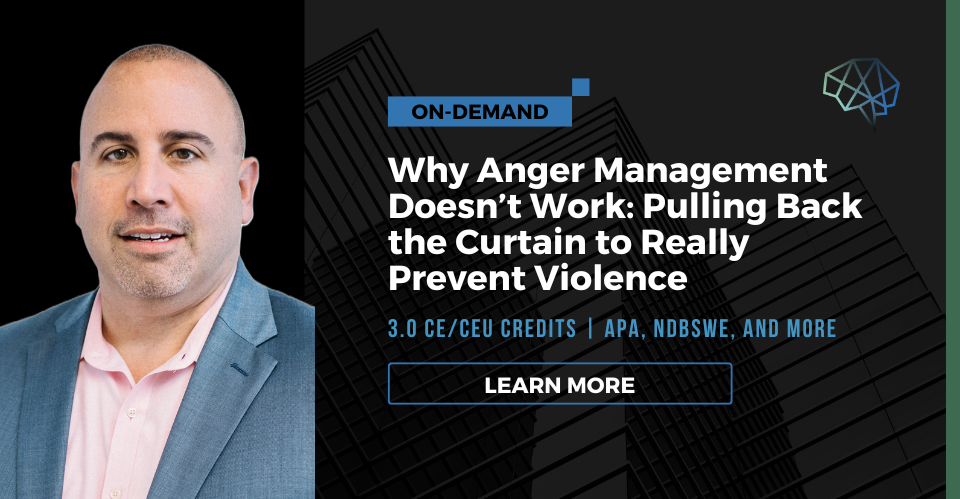
Why Anger Management Doesn't Work: Pulling Back the Curtain to Really Prevent Violence
On-demand (recorded) content
3.0 CE credit hours
CE/CEU credits included: 3.0 (see below for approval details). You must view the full webinar and pass the quiz (details below) to receive continuing education credits (partial credit not awarded).
Format: On-demand (recorded/asynchronous)
Quiz: there is a quiz at the end to ensure viewing, which you must pass (75%) within 3 attempts. If you do not pass within 3 attempts, you must repurchase the course for additional attempts. It is required by CE/CEU approval organizations.
Investment: $99 + tax
Course access: Paid registrants have lifetime access to this course (for the lifetime of this course and/or course portal).
Presenter: Mitch Abrams, PsyD, LP (see bio below)
Abstract:
Traditional anger management programs have long been promoted as a primary strategy for reducing aggression and violence. However, despite decades of implementation across courts, schools, workplaces, and treatment settings, violence rates have not meaningfully declined. One reason for this failure is that many approaches are built on a fundamental misunderstanding of anger itself. Anger is a normal emotional response to perceived provocation or injustice and is not inherently pathological. In fact, problems arise not from the experience of anger but from how individuals interpret, regulate, and act upon it. This presentation challenges the simplistic notion that anger must be suppressed or eliminated. Instead, it examines how physiological arousal, cognitive distortions, and hostile attribution biases contribute to reactive aggression and violent behavior. Participants will learn to differentiate between anger, aggression, hostility, and violence, and to recognize how distorted perceptions of threat and limited problem-solving skills can escalate ordinary conflict into harmful outcomes.
Drawing on principles from cognitive, behavioral, and forensic psychology and emotion regulation, the workshop introduces practical strategies for identifying triggers, managing arousal, and improving decision-making during emotionally charged situations. Emphasis is placed on helping individuals regain control over their emotional “flame” rather than attempting to extinguish it. By reframing anger as a manageable and potentially productive emotion, this program offers a more effective framework for preventing violence. Attendees will gain tools to help clients move beyond outdated anger management models toward approaches that improve emotional regulation, problem-solving, and behavioral outcomes in everyday life.
Objectives:
- Differentiate between anger, aggression, hostility, and violence, and explain how misunderstandings of these concepts contribute to ineffective anger management interventions.
- Identify how physiological arousal, cognitive distortions, and hostile attribution bias contribute to reactive aggression and violent behavior.
- Apply evidence-informed strategies to help individuals regulate emotional arousal, identify triggers, and improve decision-making in high-emotion situations to reduce the risk of violence.
Non-Discrimination:
HPC and ATAGF do not discriminate on the basis of race, color, national origin, religion, sex, gender identity, disability, military status, sexual orientation, or age.
Conflict of Interest Statements:
There is no known commercial support for this program, nor are there any relationships between the CE sponsor, presenting organization, presenter, program content, research, grants, or other funding that could be construed as conflicts of interests. Dr. Abrams receives an honorarium for instructing this course and royalties from his books. There is no commercial support or benefits for endorsement of products (e.g., books, training, drugs).
The presenter will inform participants of the utility and validity of content discussed (including the basis for statements about utility/validity), as well as limitations of the approach and the most common and severe risks, if any, associated with program content.
Requests for Accommodations:
HPC and ATAGF are committed to accessibility and non-discrimination in all aspects of its continuing education activities. Participants with special needs should contact program organizers so reasonable accommodations can be made.
To request accommodations, contact ATAGF's Continuing Education Vice Chair, Christine Boulton-Olson, PhD, LP, at training@grandforkstherapy.com.

Presenter: Mitch Abrams, PsyD, LP
Dr. Mitch Abrams is a licensed psychologist and is widely recognized as one of the only sport, clinical, and forensic psychologists in the world who also actively practices forensic psychology. For over 25 years, he has worked at the intersection of psychology, athletics, and behavioral risk, helping athletes, coaches, and organizations understand how powerful emotions—particularly anger—can influence performance and behavior. His work focuses on helping athletes optimize performance while reducing athlete transgressions by teaching how anger can be effectively harnessed and directed.
Dr. Abrams is the founder of Learned Excellence for Athletes and Abrams Psychological Services, where he provides sport psychology consultation, forensic evaluations, and clinical services to athletes ranging from youth competitors to professionals.
A Fellow of both the American Psychological Association’s Division 47 (Society for Sport, Exercise & Performance Psychology) and the Association for Applied Sport Psychology (AASP), Dr. Abrams is an internationally recognized speaker who provides continuing education workshops for psychologists, coaches, and performance professionals.
Dr. Abrams developed the Abrams Model of Violence Prevention, which integrates Risk–Need–Responsivity (RNR) methodology with sport psychology and calls for comprehensive prevention, risk assessment, and targeted treatment for potential perpetrators in athletics. He serves as Chief Psychologist for University Correctional Healthcare at Rutgers, overseeing mental health services in New Jersey’s State Prisons and is also the author of the recently released, I’m Not F*cking Angry!: Adjust the Flame to Get What You Want and Need.
Other Courses You May Like
We offer a range of courses focused on ethics, couples/relationship therapy, athlete mental health, and more!



Course Curriculum
Continuing Education Approvals (CE/CEU)
This course is available for 3.0 continuing education hours. Full viewing is required; credit will not be given for partial viewing. You must pass the quiz at the end (75%) within 3 attempts. To get additional attempts, you must repurchase the course.
Continuing education credit note: Many licensing boards will accept continuing education credits from other state boards as long as the approval is the same license type. If you are not sure, check with your licensing board to see if they will accept any of these approvals.
This course is co-sponsored by Assessment and Therapy Associates of Grand Forks.
Psychologists: Assessment and Therapy Associates of Grand Forks, PLLC is approved by the American Psychological Association to sponsor continuing education for psychologists. Assessment and Therapy Associates of Grand Forks, PLLC maintains responsibility for this program and its content.
New York State Licensed Psychologists: Assessment and Therapy Associates of Grand Forks/Haugen Performance Consulting is recognized by the New York State Education Department's State Board for Psychology as an approved provider of continuing education for Licensed Psychologists (#PSY-0328).
ND Licensed Social Workers: Assessment and Therapy Associates of Grand Forks, PLLC, is approved by the North Dakota Board of Social Work Examiners (NDBSWE) to sponsor continuing education for social workers in North Dakota (approval through 4/5/27).
ND Licensed Counselors: This course is approved by the North Dakota Board of Counselor Examiners (NDBCE) for 3.0 continuing education hours (approval through 3/11/27).
ND Licensed Addiction Counselors: Assessment and Therapy Associates of Grand Forks is an approved continuing education provider for the North Dakota Board of Addiction Counseling Examiners (NDBACE; approval through 1/29/27).
ND Licensed Nurses: Per correspondence with the North Dakota Board of Nursing (NDBON) on 11/19/25, contact hours approved by any other health care regulatory board (e.g., board of social work examiners [NDBSWE]) within the state or out-of-state will be accepted as meeting the NDBON requirements. You are encouraged to check with them to ensure this information is still accurate.
ND Certified Peer Support Specialists: This program is approved for continuing education credits for North Dakota Certified Peer Support Specialists.
Paid registrants have lifetime course access.
To view our workshop policies, including refund policy, please click here.
Join this on-demand course for
$99 + tax (3 CE credits)!
Clicking the button below will bring you to a registration page where you enter information that will be on your CE certificate.
After you submit that form, you will be directed to the payment page for the course that you select.
You will not be enrolled in the course until you submit your payment information.